
System Selection
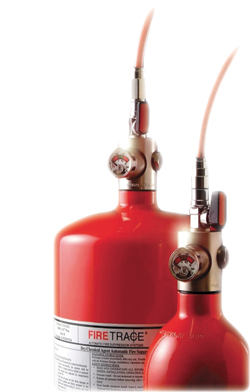
FIRETRACE systems used in buses consists of small container, which remain under compressed pressure, and uses ABC chemical drying as extinguishing factor. It is connected with a section of FIRETRACE Detection wire (FDT) and properly routed around the engine compartment, to ensure linear, pneumatic detection at entire length and circumference.
In case of fire or rise of high temperature, FDT explode and liberate Chemical Dehumidification substance directly at the source of fire, to extinguish it immediately. The substance quickly fills the engine compartment area, partly remaining in it and absorbs some other flammable liquids to prevent from re-ignition. The substance is not toxic, suitable to use in case of fire caused by electric current and all liquids and has been running at low pressure, about 10 bar (150 PSI).
The whole system is equipped with a pressure switch which continuously monitors the contents of the container and can be used to raise the alarm in the cab, in case of notification by the system about the fire.
Cable Detection FIRETRACE is ideal for the detection of fire in buses and tolerates any kind of vibration, pollution and extreme temperatures, in which buses are being operated. Thanks to pneumatic control, work of the cable does not need any energy from the bus, and therefore does not have an extra load on electrical system of the bus.
After the substance has been released, the surface should be cleaned away from powder in the engine compartment. To systems based on the water are added the antifreeze liquid, functioning at low temperatures, which are highly corrosive. Powder particles are too large to get into the engine air filter, that's why only the outer part of the engine is being cleaned. ABC powder can be cleaned with one of the methods: wiping, vacuuming or washing exposed areas.
Department of Transport in the UK recommends Powder Chemical Dehumidification as the most effective way to extinguish fires in the engine compartment.
...Systems based on water can be used in passenger compartments, but they are not as efficient as particle systems extinguishing the fire engine. Automated systems are ideal for the motor engine, but are not suitable to extinguish the passenger compartment due to the lack of control over the content and direction of powder spread. Manual systems are known as effective only when appropriate staff are trained in their use.
FIRETRACE systems used in buses consists of small container, which remain under compressed pressure, and uses ABC chemical drying as extinguishing factor. It is connected with a section of FIRETRACE Detection wire (FDT) and properly routed around the engine compartment, to ensure linear, pneumatic detection at entire length and circumference.
In case of fire or rise of high temperature, FDT explode and liberate Chemical Dehumidification substance directly at the source of fire, to extinguish it immediately. The substance quickly fills the engine compartment area, partly remaining in it and absorbs some other flammable liquids to prevent from re-ignition. The substance is not toxic, suitable to use in case of fire caused by electric current and all liquids and has been running at low pressure, about 10 bar (150 PSI).
The whole system is equipped with a pressure switch which continuously monitors the contents of the container and can be used to raise the alarm in the cab, in case of notification by the system about the fire.
Cable Detection FIRETRACE is ideal for the detection of fire in buses and tolerates any kind of vibration, pollution and extreme temperatures, in which buses are being operated. Thanks to pneumatic control, work of the cable does not need any energy from the bus, and therefore does not have an extra load on electrical system of the bus.
After the substance has been released, the surface should be cleaned away from powder in the engine compartment. To systems based on the water are added the antifreeze liquid, functioning at low temperatures, which are highly corrosive. Powder particles are too large to get into the engine air filter, that's why only the outer part of the engine is being cleaned. ABC powder can be cleaned with one of the methods: wiping, vacuuming or washing exposed areas.
Department of Transport in the UK recommends Powder Chemical Dehumidification as the most effective way to extinguish fires in the engine compartment.
...Systems based on water can be used in passenger compartments, but they are not as efficient as particle systems extinguishing the fire engine. Automated systems are ideal for the motor engine, but are not suitable to extinguish the passenger compartment due to the lack of control over the content and direction of powder spread. Manual systems are known as effective only when appropriate staff are trained in their use.
Languages: 

