
What happens if more than one fire ignite at the same time in the engine compartment?
Because the system is adapted to the capacity of the engine compartment, in the container is located substance sufficiency to extinguishing fire on the entire surface. If there is more than one fire, wire fire detection, first explode in the hotest spot, and the entire agent will be spread from that point. However, the entire area of the engine compartment will be filled quickly with cloud of dry chemical agent, which rapidly extinguish other possible ignition sources.
If the system will extinguish the fire, why the driver needs to know that the system worked?
A common source of fire in buses is an electric or mechanical defect, damage of parts such as motor starter, fuel pump or a turbo unit. If it was intended to continue driving the bus, after the fire was extinguished, then the faulty unit could start a fire again. That could cause a situation where there would be no longer any active fire protection system. Stopping the bus would stop fuel supply and eliminate electric defect by cutting off the power.
If the system is activated, do I have to replace the entire system?
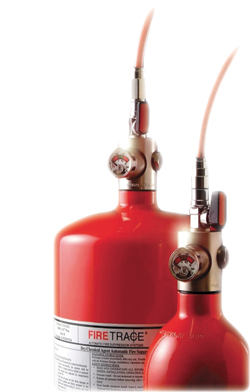
No. In case of fire and system's activation, some action must be taken to make the system reactivated. This includes re-loading the contents of the container or its replacement. In normal circumstances, fire detection cable does not need to be replaced, because the point of explosion may be cut off from the cable and the cable can be connected again by a simple hole plug. The system can be filled with pressure and restored to use. In theory, the system can be operated again in just a few minutes and at the lowest cost.
Does chemical dehumidification powder damage the engine?
No. However, following the description of fire extinguish by releasing of any chemical agent, cleaning will be necessary. The same applies to fire-extinguishing systems based on the water, as they contain chemical additives to prevent freezing. This may consist of wiping down, vacuuming and washing exposed areas, and in some cases, the powder must be scraped off, if while unloading, surface area was hot. The powder would not pass through air filters and will not affect the engine work.
Because the system is adapted to the capacity of the engine compartment, in the container is located substance sufficiency to extinguishing fire on the entire surface. If there is more than one fire, wire fire detection, first explode in the hotest spot, and the entire agent will be spread from that point. However, the entire area of the engine compartment will be filled quickly with cloud of dry chemical agent, which rapidly extinguish other possible ignition sources.
If the system will extinguish the fire, why the driver needs to know that the system worked?
A common source of fire in buses is an electric or mechanical defect, damage of parts such as motor starter, fuel pump or a turbo unit. If it was intended to continue driving the bus, after the fire was extinguished, then the faulty unit could start a fire again. That could cause a situation where there would be no longer any active fire protection system. Stopping the bus would stop fuel supply and eliminate electric defect by cutting off the power.
If the system is activated, do I have to replace the entire system?
No. In case of fire and system's activation, some action must be taken to make the system reactivated. This includes re-loading the contents of the container or its replacement. In normal circumstances, fire detection cable does not need to be replaced, because the point of explosion may be cut off from the cable and the cable can be connected again by a simple hole plug. The system can be filled with pressure and restored to use. In theory, the system can be operated again in just a few minutes and at the lowest cost.
Does chemical dehumidification powder damage the engine?
No. However, following the description of fire extinguish by releasing of any chemical agent, cleaning will be necessary. The same applies to fire-extinguishing systems based on the water, as they contain chemical additives to prevent freezing. This may consist of wiping down, vacuuming and washing exposed areas, and in some cases, the powder must be scraped off, if while unloading, surface area was hot. The powder would not pass through air filters and will not affect the engine work.
Languages: 

